
Collection: Women's Grey Jackets
-
Peyvand (Bond) Reversible Jacket
Regular price $459.00 AUDRegular priceUnit price per -
Jâm (Chalice of Truth) Reversible Long Jacket
Regular price $239.00 AUDRegular priceUnit price per -
Bitâb (Restless) Reversible Jacket
Regular price $319.00 AUDRegular priceUnit price per -
Hamnava (In harmony) Reversible Jacket
Regular price $319.00 AUDRegular priceUnit price per -
Vatan (Homeland) Jacket
Regular price $269.00 AUDRegular priceUnit price per -
Mottasel (Bound in Union) Jacket
Regular price $379.00 AUDRegular priceUnit price per -
Sâmandar (Fire Guardian) Jacket
Regular price $379.00 AUDRegular priceUnit price per -
Najvâ (Whisper) Hooded Reversible Jacket
Regular price $299.00 AUDRegular priceUnit price per -
Delrobâ (Charming) Jacket
Regular price $329.00 AUDRegular priceUnit price per -
Charkh-e Kaboud (Azure Dome) Jacket
Regular price $379.00 AUDRegular priceUnit price per -
Bî-hamegân (Without Others) Jacket
Regular price $379.00 AUDRegular priceUnit price per -
Âfâgh (Horizons) Jacket
Regular price $379.00 AUDRegular priceUnit price per


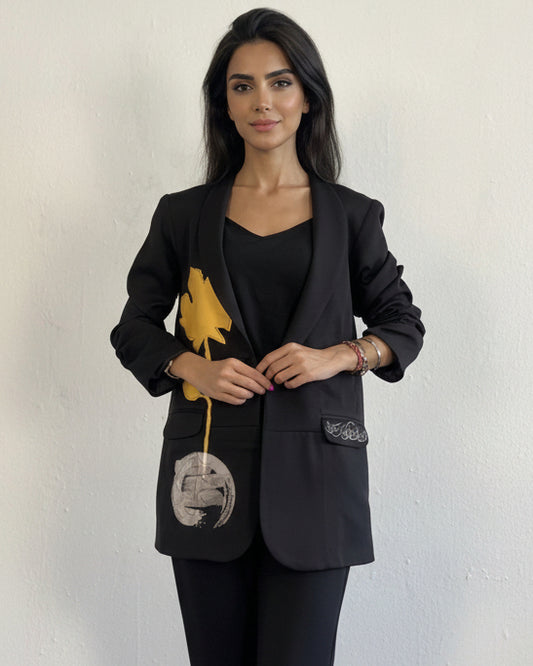

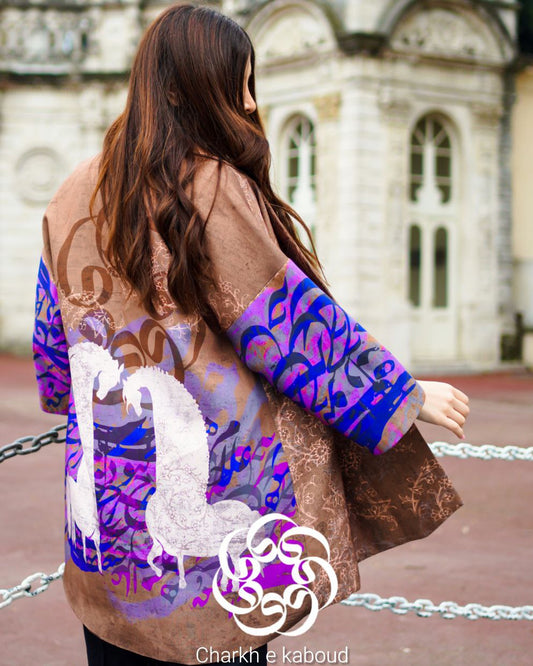

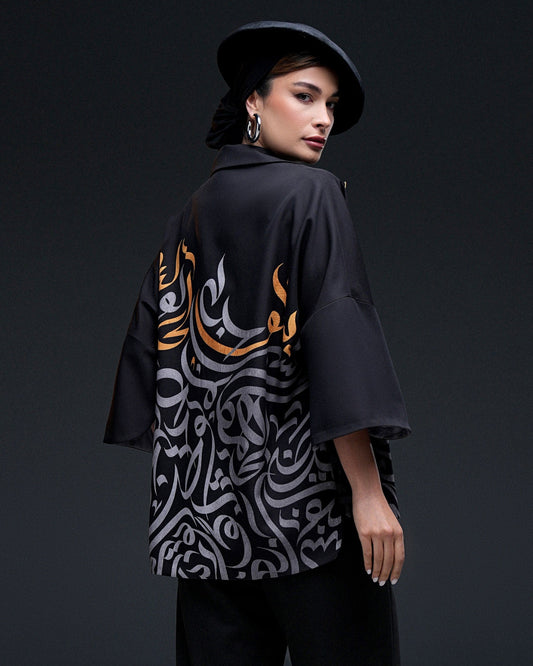


Explore women's grey jackets where colour is part of the artwork, not merely a label. At Tâghè, our designs bring contemporary clothing into conversation with Persian poetry, visual expression and cultural memory. This selection sits within our broader Women's Jackets collection. Discover grey alongside carefully considered contrasts, compare the individual designs and explore the meanings of their Persian names. Whether you prefer a restrained palette or a composition with several colours, begin with the artwork and choose a piece that speaks to you.
Explore Tâghè's Grey Jacket Collection
There is more than one way for grey to appear in a jacket. It might sit alongside black or silver, form part of an arrangement with blue or green, or appear within a composition containing several contrasting colours. Across Tâghè's grey jacket selection, the common thread is that grey is recorded among each product's colours. The individual designs are not interchangeable, and their photographs offer a much clearer picture than a colour label alone.
The collection brings together twelve named jackets. To make them easier to compare, the guide below shows the colours recorded for each piece and a practical detail worth checking. These are catalogue descriptors, not verified statements about which colour covers the largest area of a garment. The artwork itself remains the reference for its visible appearance.
| Design | Recorded colours | What to compare |
|---|---|---|
| Âfâgh (Horizons) | Grey, blue | How the grey and blue appear in the complete artwork |
| Bî-hamegân (Without Others) | Grey, black, yellow | The balance between neutral and contrasting colours |
| Bitâb (Restless) Reversible | Grey, red, rose gold | The colour composition and documented reversible design |
| Charkh-e Kaboud (Azure Dome) | Grey, brown, beige, purple | How several recorded colours relate within one composition |
| Delrobâ (Charming) | Grey, black | The artwork within a two-colour recorded palette |
| Hamnava (In Harmony) Reversible | Grey, green, orange | Colour contrasts and the available views of the design |
| Jâm (Chalice of Truth) Reversible Long | Grey, black, gold | The gold elements and the product's recorded design features |
| Mottasel (Bound in Union) | Grey, silver, beige | The distinction between the neutral tones in photographs |
| Najvâ (Whisper) Hooded Reversible | Grey, black, yellow | The hooded detail and overall colour arrangement |
| Peyvand (Bond) Reversible | Grey, red, hot pink, multicolour | Which colours and motifs are most visible in the artwork |
| Sâmandar (Fire Guardian) | Grey, black, red | How the contrasting colours interact in the imagery |
| Vatan (Homeland) | Grey, green, multicolour | The full composition rather than a single colour swatch |
If a restrained set of recorded colours is your starting point, compare Delrobâ with Mottasel: the former lists grey and black, while the latter combines grey with silver and beige. This does not establish which is visually quieter; that is a judgement best made from the photographs. It does help you choose which designs to inspect first.
For more pronounced colour combinations, consider Âfâgh with blue, Hamnava with green and orange, or Sâmandar with black and red. Charkh-e Kaboud and Peyvand offer further examples where several colours are recorded. Rather than assuming that more listed colours means a busier appearance, compare the complete images and identify the details that actually attract your attention.
The names also provide a distinctive way into the collection. Âfâgh invites thoughts of horizons, Vatan of homeland, and Mottasel of union. These themes do not tell you how the jackets look, but they can make the difference between two designs you find equally compelling. Start with the visual choice; allow the story to add meaning.
How to Choose a Women's Grey Jacket
A useful choice begins with three questions: Which grey do I see in the photographs? What other colours share the design? And which verified features matter to me? Answering them in that order helps separate visual preferences from assumptions about a product. You can then consider the Persian name and artistic inspiration as a further reason to choose one piece over another.
Check the Shade and Placement of Grey in Product Images
Grey is a broad colour description, not a guarantee of a particular shade. It can appear cooler or warmer to the eye, and its character may change when seen next to blue, beige, black or a more vivid colour. The product export confirms that grey is associated with the jackets in this collection; it does not independently verify a precise shade, a colour code or the area occupied by grey within each composition.
Begin with the primary photograph, then examine every available additional view. Ask where grey appears: is it part of a motif, an area of contrast or a larger section of the visible artwork? Does another colour draw your attention first? Two jackets can both be catalogued as grey yet offer very different visual experiences.
Take Âfâgh and Charkh-e Kaboud as examples. The first records grey and blue, while the second records grey, brown, beige and purple. Those descriptors help identify what to look for, but they cannot tell you the precise shade or placement. A close look at the actual images is the only sensible way to judge the composition as presented online.
Also consider the conditions in which you view product photography. Lighting, editing and display settings can influence how close shades appear, especially when comparing grey with silver or beige. This is not a reason to distrust the photographs; it is a reminder not to treat a digital image as an exact colour specification. Where colour precision is important to your purchase, request clarification from the Tâghè team before ordering.
Once you have established which designs appeal visually, compare them side by side. You may discover that the role of grey in the artwork matters more to you than the shade name itself. This is particularly relevant to a collection built around artistic compositions rather than plain-colour jackets.
Compare Grey with Other Colours in Each Design
A stronger comparison looks at relationships between colours, not simply at how many are listed. Start by identifying the jacket's most noticeable visual element, then consider whether the other colours support it, contrast with it or change the overall mood.
For a comparison within a narrower recorded palette, look at Delrobâ (grey and black), Âfâgh (grey and blue) and Mottasel (grey, silver and beige). Each suggests a different direction for browsing. Delrobâ may interest someone looking first at a grey-and-black listing; Âfâgh someone drawn to blue; and Mottasel someone comparing neighbouring neutral tones. Their photographs, rather than the catalogue entries alone, determine the final visual impression.
Among designs with red in their recorded colours, Bitâb, Peyvand and Sâmandar deserve separate attention. Bitâb lists grey, red and rose gold; Peyvand lists grey, red, hot pink and multicolour; Sâmandar lists grey, black and red. A shared red descriptor does not mean these jackets use red in the same way. Compare their artwork to see whether the colour appears as a small detail or plays a more noticeable role.
Hamnava and Vatan both include green among their recorded colours, but the remaining entries differ: Hamnava includes orange, while Vatan includes multicolour. Similarly, Bî-hamegân and Najvâ both record grey, black and yellow, despite being separate products with different design names and features. These pairings are useful starting points for a deliberate comparison, not evidence that the artworks are visually alike.
When you have narrowed the collection to two or three possibilities, revisit the images without focusing on the product names. Which design would you recognise immediately? Which detail do you keep returning to? Then read the names and their meanings again. That sequence gives both the artwork and its story a fair place in your decision.
Consider Each Jacket's Individual Features
The grey classification is shared, but the jackets do not all carry the same product descriptors. Najvâ is specifically identified as a Hooded Reversible Jacket. Bitâb, Hamnava and Peyvand are also identified as reversible, while Jâm is listed as a Reversible Long Jacket. These distinctions are useful when a feature matters as much as the colour.
If two-sided design is a priority, our women's reversible jackets collection is the more focused place to compare that characteristic. The purpose of this page is different: it brings together designs associated with grey, including reversible and non-reversible products. A jacket can belong to both collections without having two competing product identities.
Two designs in this grey selection, Jâm and Peyvand, also appear in the women's lightweight jackets collection. That second page is organised around the lightweight descriptor, not colour. Do not infer from these examples that every grey jacket is lightweight, or that the category name confirms an exact garment weight.
Beyond these confirmed designations, consult the individual product information for anything important to your choice. The collection name does not establish a fabric, a precise garment weight, weather protection, or other technical specifications. If you need a detail that is not available in the listing, ask before ordering rather than relying on a general assumption about grey jackets.
Finally, consider your reason for choosing the jacket. Are you responding primarily to its colour combination, a particular artistic element, or the meaning of its Persian name? Clear priorities make it easier to choose among designs that are all valid members of the same colour collection.
How to Style a Grey Jacket
The best styling direction begins with the particular jacket, not a universal rule about the colour grey. A design with black and grey listed may invite a different combination from a jacket incorporating grey, blue, purple or orange. The goal is to make the artwork legible within the outfit and decide what deserves the most attention.
Grey Jacket Outfits with Neutral Colours
Black, white, beige and other restrained colours can give the eye a quieter setting in which to appreciate the jacket. For a grey design with detailed artwork, you might begin with one neutral colour elsewhere in the outfit and decide whether an additional accent is needed at all. This is a matter of visual balance rather than a rule that every grey jacket must be styled the same way.
Imagine comparing Delrobâ and Mottasel. The former's recorded grey-and-black pairing offers a clear reason to explore combinations involving black; the latter's grey, silver and beige entries suggest looking at softer neutral relationships. Neither listing proves that a specific shade dominates the finished design. Use the photographs to choose an accompanying colour that complements the artwork you actually see.
One practical approach is to select a single element from the jacket and echo it discreetly elsewhere. If a dark detail is what catches your attention, consider letting that detail connect visually with another part of your outfit. If the jacket's artwork already has several areas of contrast, you may prefer not to introduce another competing pattern.
Neutral does not mean lacking personality. A restrained surrounding palette can bring a culturally meaningful design into clearer focus. The jacket remains the expressive element, while the other pieces support the overall composition.
Adding Colour Around a Grey Jacket's Artwork
If you want a more colourful combination, take one accent from the jacket's visible artwork rather than trying to repeat every colour recorded in its catalogue entry. This creates a relationship without making the surrounding outfit a copy of the jacket.
With Âfâgh, begin by examining the grey-and-blue combination in the photographs. If blue is an element you would like to emphasise, a blue accessory may create a connection. With Hamnava, look at how green and orange appear alongside grey before choosing whether either colour deserves an echo elsewhere. These are suggestions for visual experimentation, not claims about precisely where a colour appears on either garment.
Red provides another example. Bitâb, Peyvand and Sâmandar all include red in their recorded colour information, yet their additional colours differ. You might choose to draw attention to red in one outfit and, in another, let the jacket supply all the colour while the surrounding pieces remain understated. What works depends on the artwork, not simply the category label.
For designs with several recorded colours, such as Charkh-e Kaboud and Vatan, start by deciding which element of the actual composition you value most. Selecting one visual cue is more useful than trying to build an outfit around an entire metadata list.
Colour is only one reason to wear Tâghè. If the name Vatan brings to mind home, or Âfâgh suggests a wider horizon, that meaning can be part of the choice too. The artistic reference does not dictate an outfit, but it can make wearing the design more personal.
Persian Art and Stories Behind Tâghè's Grey Jackets
Colour may guide a shopper to this collection, but the names distinguish Tâghè from a conventional list of grey jackets. Their inspirations come from Persian poetry and storytelling, where ideas of belonging, attachment, perspective and change have long been expressed through memorable images. These references are part of the creative context of the products; they are not a substitute for the photographs or product details.
For this grey collection, seven designs outside the dedicated reversible range offer particularly useful stories to explore: Âfâgh, Bî-hamegân, Charkh-e Kaboud, Delrobâ, Mottasel, Sâmandar and Vatan. The five reversible designs belong here too, but their two-sided feature is explored more fully in its own collection.
The Meaning Behind the Designs' Persian Names
Âfâgh (Horizons) draws on poetry attributed in the product description to Hatef Esfahani. The imagery encourages looking beyond immediate appearances and discovering what becomes visible through a different kind of attention. The title Horizons is an inviting point of entry for a piece whose recorded colours include grey and blue. It suggests openness and perspective without claiming that the artwork depicts a literal horizon.
Bî-hamegân (Without Others) is inspired by a verse attributed to Rumi. Its theme is the irreplaceable presence of a particular person: being without others is possible, while being without that one person feels different. The name carries an emotional meaning of attachment and absence. In this collection, the jacket's recorded grey, black and yellow colours provide the visual starting point; its name adds another way to connect with the design.
Charkh-e Kaboud (Azure Dome) refers to the sky through a literary expression associated with Hafez. The source verse reflects on freedom from attachment. That idea is different from simply admiring a colour or pattern: it gives the name a philosophical dimension. Its combination of recorded grey, brown, beige and purple offers a separate visual question for the shopper, one best answered by studying the artwork itself.
Delrobâ (Charming) takes inspiration from poetry attributed to Rumi. The source expresses admiration and a searching question about someone deeply valued. The name speaks to attraction and affection, while the jacket's grey-and-black colour listing makes it a useful option to compare with other, more varied recorded palettes. Neither its story nor its catalogue colours should be used to invent details that are not shown in the product.
Mottasel (Bound in Union) also refers to writing attributed to Rumi. Its name suggests union, closeness and the relationship between things that might otherwise appear separate. That idea can make the piece meaningful to someone interested in connection as a theme. Mottasel's grey, silver and beige colour entries then provide a distinct visual comparison with Delrobâ and other jackets in the collection.
Sâmandar (Fire Guardian) draws on the imaginative world described in its product information rather than a verse attributed to a named poet. The figure of Sâmandar is associated there with fire and a movement from danger towards a new beginning. The artwork's recorded grey, black and red colours offer another way to approach the design, while its name introduces a narrative of transformation. It is important to distinguish this supplied product story from a verified historical account of a particular myth.
Vatan (Homeland) brings the focus to identity and origin. Its product description credits Alireza Shojapour and links the name to the place a person calls home. That reference may carry particular meaning for people with connections to Persian language and culture, while remaining accessible through its English meaning. Vatan's grey, green and multicolour listing provides the practical colour context for choosing the actual jacket.
The remaining five grey designs have names and stories worth acknowledging without repeating the full descriptions from other collection pages. Bitâb (Restless) draws on longing in poetry attributed to Ahmad Shamloo, while Hamnava (In Harmony) references Saeb Tabrizi and a moment of shared accord. Jâm (Chalice of Truth) is linked in its product description to Omar Khayyam and the legendary Cup of Jamshid. Peyvand (Bond) takes its idea of enduring connection from poetry attributed to Shahryar. Najvâ (Whisper) contributes its evocative name and its specifically documented hooded, reversible design.
These references are not all versions of the same story. Âfâgh considers perspective; Charkh-e Kaboud considers attachment; Vatan considers belonging; Sâmandar introduces change. Understanding those differences gives you a more distinctive basis for choosing between two artworks whose colours both appeal to you.
You do not need to know the original language to appreciate the ideas. A translated name and a carefully explained reference can open the door, while the visual composition remains available to every viewer. In that way, the cultural context adds depth without asking the customer to treat the product as a lesson in literature.
Frequently Asked Questions About Women's Grey Jackets
Can Tâghè's Grey Jackets Feature Other Colours?
Yes. Grey is recorded among the colours of each jacket in this collection, but many designs also have additional colours in their catalogue information. For example, Âfâgh lists blue alongside grey, Hamnava lists green and orange, and Jâm lists black and gold. The photographs show how those colours contribute to the actual artwork, so use them rather than assuming the jacket is entirely grey.
Are All Tâghè Grey Jackets Reversible?
No. Five products in this selection are explicitly identified as reversible: Bitâb, Hamnava, Jâm, Najvâ and Peyvand. The other seven jackets are not labelled as reversible in their product titles. If two-sided design is a deciding feature, confirm it in the individual product information rather than applying that characteristic to the whole grey collection.
How Can I Confirm the Grey Colour Before Ordering?
Review the available photographs for the exact jacket you are considering. Compare different views, and remember that lighting and screen settings can affect the way a shade appears. If you need confirmation of a particular grey tone or cannot identify the grey areas clearly, contact Tâghè with the full product name and ask for clarification before ordering.